How to play
Egyptian Ratscrew
Also known as ERS, Egyptian War, Slap.
- Players
- 2–6
- Play time
- 15 min
- Difficulty
- Easy
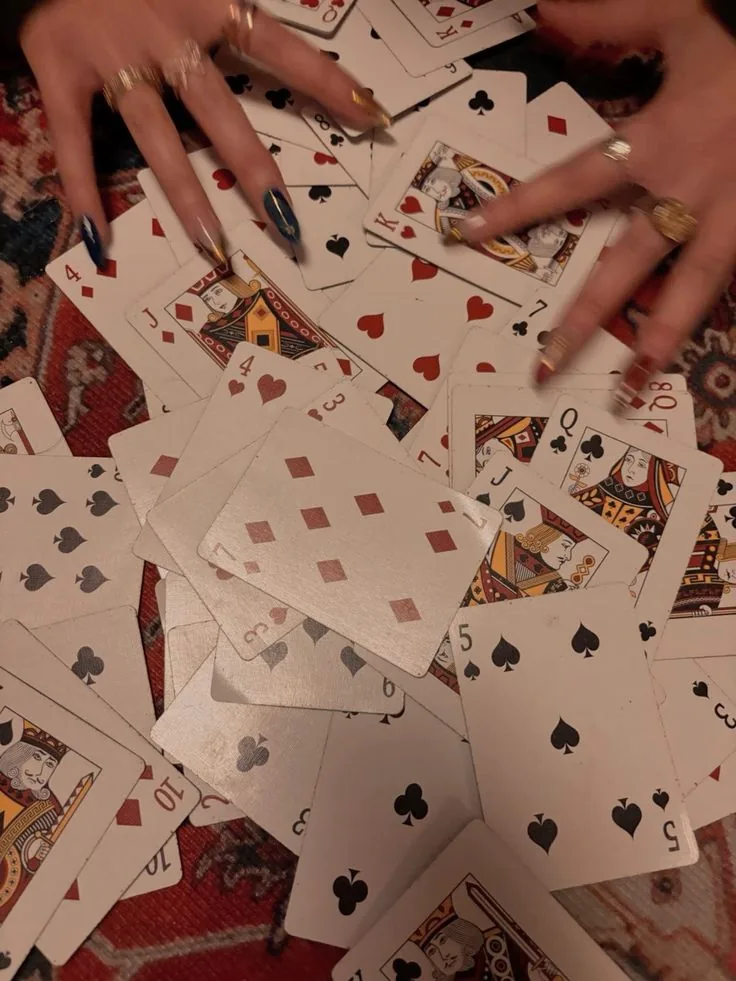
Play in 90s
Deal all cards face-down, no peeking. Players take turns flipping one card to the center. Slap the pile when you see: doubles (pair), sandwiches (matching cards with one between), or a top + bottom match. Fastest slapper takes the pile. If someone plays a face card or Ace, the next player has limited tries to play another (J=1, Q=2, K=3, A=4); fail and the previous face-card player takes the pile. Win = collect all cards.
Egyptian Ratscrew is what happens when you cross War with Speed and add a slapping mechanic. Players don’t take real turns — they take token turns, flipping cards onto a pile, until a pattern emerges that anyone at the table can claim by slapping the pile first. The game is forty percent reflex, forty percent pattern recognition, twenty percent making sure no one breaks a finger. It’s the game most groups play once and then end up playing for two hours.
What you need
A standard 52-card deck. Two to six players. A flat surface that doesn’t mind being slapped. Hand jewellery off; you will slap each other’s hands by accident.
Setup
Deal the entire deck out evenly to all players, face down. Players don’t look at their cards — the deck stays as a face-down stack in front of each player.
How to play
Flipping
Going clockwise, each player takes the top card of their stack and flips it face up onto a central pile. Play moves quickly — there’s no thinking involved in the flip itself.
Face-card challenge
When a player flips a face card or an ace (J, Q, K, A), the next player has to flip face cards as a “challenge”: 4 chances after an ace, 3 after a king, 2 after a queen, 1 after a jack. If they flip a non-face card during their challenge, the player who flipped the original face card wins the entire pile and takes it to the bottom of their stack. If they flip another face card, the chance count resets for the next player.
Slap conditions
Any time the pile shows a “slappable” pattern, any player can slap the pile. First hand to touch the pile wins it. Standard slap conditions: doubles (two consecutive cards of the same rank), sandwiches (two cards of the same rank with one different card between them), and runs (three or more consecutive ranks, regardless of suit, ascending or descending).
Wrong slaps
If you slap when the pattern isn’t actually there, you give one card from the bottom of your stack to whoever flipped the most recent card. Stops the game from devolving into pre-emptive slapping.
Out of cards
If you run out of cards but haven’t lost yet (i.e., the pile hasn’t resolved), you stay in the round and can slap your way back. You’re only out when you have no cards and you fail to slap into a pile.
How you win
The last player still holding cards wins. Most rounds end in five to fifteen minutes — quicker with more players, slower with two.
Common variations
House slap rules
Some groups add slap conditions: top-bottoms (top card matches the card directly below it), tens (any pair adding to ten), or the four-of-a-kind. Pick a stable set at the start of the round; don’t add new ones mid-game.
No-flick rule
A common house rule: cards must be flipped away from yourself, so the flipping player doesn’t see the card before opponents. Levels the reflex playing field.
Strategy
- Keep your eyes on the top of the pile, not on your stack. The cards in your stack don’t matter; the pattern in the pile is everything.
- Slap with a flat hand, not a closed fist. You will hit other people’s hands and you don’t want to actually hurt them.
- On a face-card challenge, if you’re the challenger, count off the chances out loud — slows you down just enough to read each card properly.
- Patience beats reflex. The fastest player isn’t always the winner; the player who reads the pile correctly is.
When to pull it out
Loud groups, late nights, four to five players. Bad for surfaces with breakable items on them. Great game for a cabin table at midnight.
Origin
Egyptian Ratscrew is a 20th-century American game with no actual Egyptian connection — the name is invented. It descends from older slapping games (notably Slapjack, the kids’ game) and from the European card game Beggar-My-Neighbour (which provides the face-card challenge mechanic).
Also in the tin