How to play
Kemps
Also known as Kent, Cash, Canes.
- Players
- 4
- Play time
- 20 min
- Difficulty
- Medium
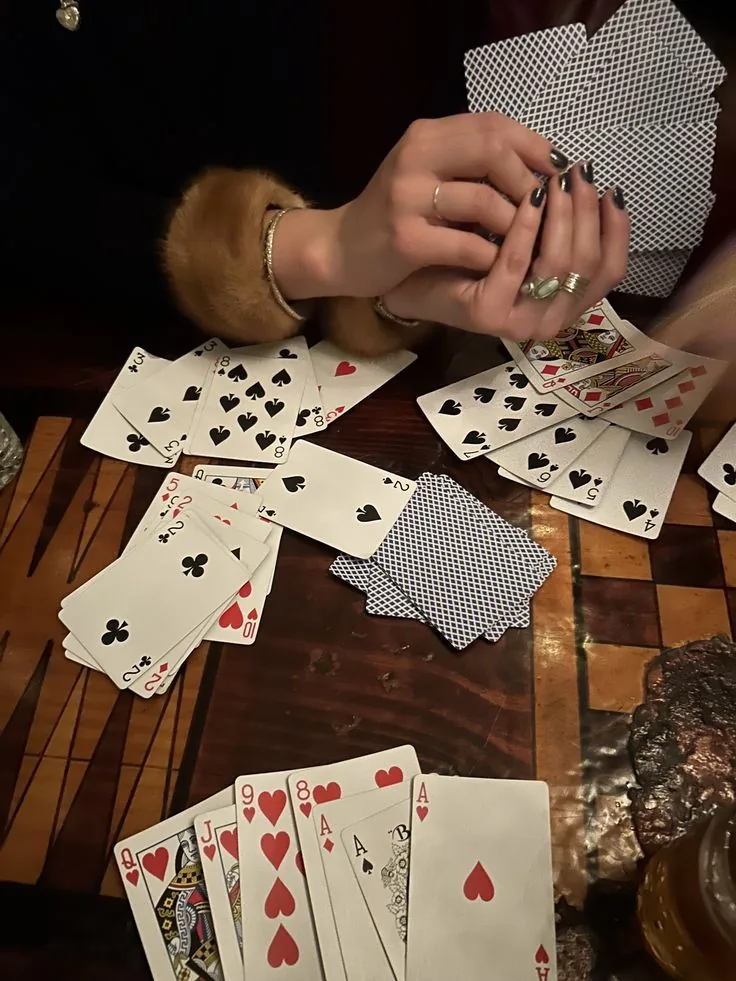
Play in 90s
Partners sit across, secretly agree on a signal (wink, nose-tap, anything). Deal 4 cards to each player; 4 face-up in the middle. On “go,” anyone can swap a card from hand with a middle card — no turns, free-for-all. When all pass, replace middle 4. When you get four of a kind, signal your partner; they shout “Kemps!” to win the round. If opponents catch your signal, they shout “Cut!” to win instead. Each loss = one letter (K-E-M-P-S); spell the word and you’re out.
Kemps is the partnership game with the secret weapon: before the round starts, you and your partner agree on a private signal — a wink, a nose-touch, a raised eyebrow — that means “I have four of a kind.” The game is a continuous swap of cards, played fast, while you keep one eye on the table and one on your partner, waiting for the moment they tip you off (or you them). The other team is doing the same thing. The first team to spot the signal — yours or theirs — and call “Kemps” wins or loses the hand.
What you need
A standard 52-card deck. Exactly four players, in two teams of two. Partners sit across from each other, not next to.
Setup
Each team agrees on a private signal beforehand, with the other team out of earshot. The signal should be subtle enough to bluff with — touching your nose, fixing your hair, a particular sigh. Deal four cards face down to each player. Place the rest of the deck off to the side; you won’t need it. Deal four cards face up in the centre of the table.
How to play
Continuous play
There are no turns. The four cards in the centre are public — any player can swap one card from their hand for one of the four centre cards, at any time, as fast as they want. Once all players are happy with the centre cards (or no one is swapping), the dealer sweeps those four cards aside and lays out four new ones from the deck.
The goal: four of a kind
You’re trying to collect four cards of the same rank — four 7s, four queens, anything. The moment you have it, signal your partner. The signal must be the agreed signal; you can’t communicate any other way during the round.
Calling Kemps
When you see your partner’s signal, call “Kemps!” loudly. Your team wins the hand. But — if you call Kemps and your partner does not in fact have four of a kind, your team loses the hand.
Calling Counter-Kemps (or Cut-Kemps)
If you spot the other team’s signal — i.e., you think one of them has four of a kind — call “Counter-Kemps!” or “Cut-Kemps!” If you’re right, your team wins the hand. If you’re wrong, your team loses the hand. The risk is symmetric.
Scoring across hands
Each loss is one letter of K-E-M-P-S. The first team to spell KEMPS loses the match. Most groups play to KEMPS over multiple hands; some play to half (K-E-M) for a shorter game.
How you win
The team that doesn’t spell KEMPS first wins. Play multiple rounds in a sitting — each round is a fresh signal-and-counter-signal dance.
Common variations
Three-of-a-kind
Beginner variant: signal on three of a kind instead of four. Faster, easier, recommended for first-time groups.
Bluff signals
Some groups allow you to throw a fake signal as a bluff — make the other team call Counter-Kemps incorrectly. Adds a layer; some groups find it ruins the central tension. Try once, decide.
Six-player Kemps
Three teams of two, six centre cards instead of four. Chaotic, fun, hard to play well. Recommended once.
Strategy
- Pick a subtle signal. Anything bigger than a small face movement gets spotted. The best signals are gestures you’d make naturally — fixing your watch, touching your hair — done with conscious deliberation when the moment matters.
- Bluff your signal early. Touch your nose in the first thirty seconds for no reason. Conditions the other team to ignore it.
- Watch your partner more than the cards. The cards are the surface; the partner’s face is the game.
- Don’t call Counter-Kemps unless you’re reasonably sure. The penalty for being wrong is the same as the penalty for missing your own partner’s signal.
When to pull it out
Exactly four players, ideally couples or close friends. Doesn’t scale. Bad for groups that don’t know each other well; great for groups that do.
Origin
Kemps is one of those games whose origin nobody can pin down — likely Anglo-American mid-20th century, possibly British scout/camp tradition. Different regions know it as Kent, Cash, or Canes, and the rules are remarkably consistent across all of them, which suggests an oral tradition of unusual reliability.
Also in the tin