How to play
Trash
Also known as Garbage, Ten Cards.
- Players
- 2–4
- Play time
- 20 min
- Difficulty
- Easy–Medium
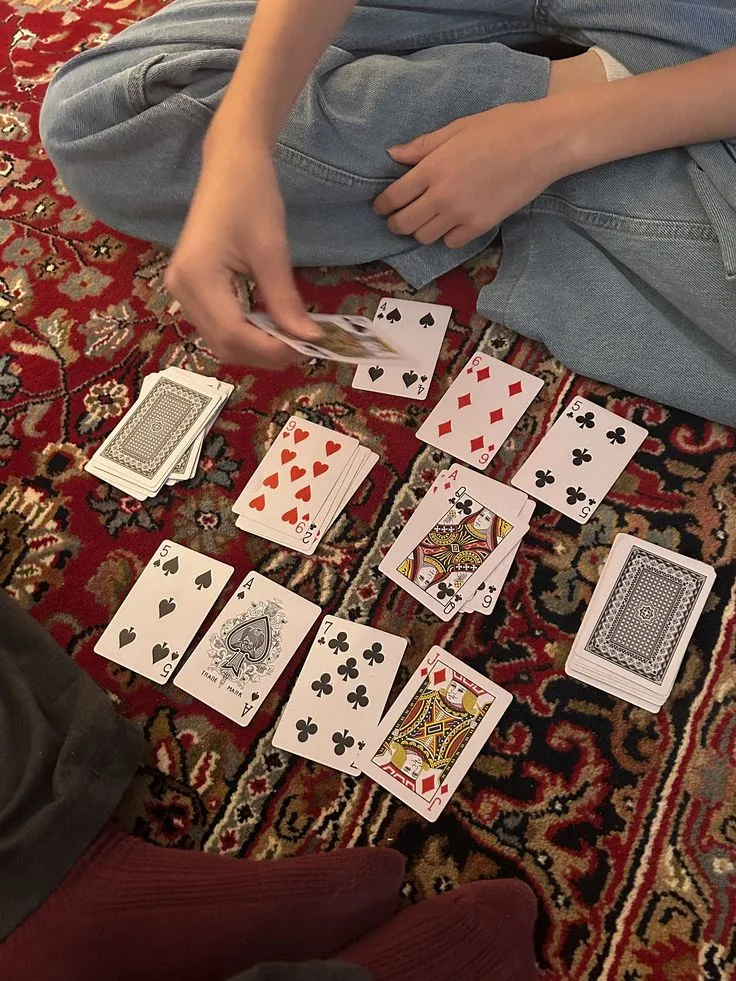
Play in 90s
Deal 10 cards face-down in a 2x5 grid to each player. On your turn, draw from the deck. If it’s A–10, place it in its numbered slot (A=1, 2=2… 10=10), flip whatever was there, and play that card next. Jacks are wild; Queens are dead (turn ends); Kings are skip (also end turn). When stuck, discard and pass. First to flip all 10 in order wins the round and drops to a 9-card grid next round. First to win a 1-card round wins the game.
Trash is the only game in the tin that rewards patience. There’s no slapping, no shouting, no bluffing — just a quiet build-down from ten cards to one, where each turn you’re trying to slot the right card into the right position and pass the rest along. It’s the game that comes out after dinner, when the table’s settled and people want something to do with their hands while the conversation winds down. It’s also the game where the last hand routinely takes longer than the first nine combined.
What you need
A standard 52-card deck. Two to four players. A surface big enough for each player to lay out ten cards in a 2x5 grid in front of them.
Setup
Deal ten cards face down to each player. Each player arranges their ten cards in a 2x5 grid in front of them, without looking at the faces. Place the remaining deck face down in the centre as the draw pile, with one card flipped face up next to it as the start of the discard pile.
How to play
Card values are positions
Each card in your grid corresponds to a position: the first card is the “Ace position,” the second is the “2 position,” and so on, with the tenth being the “10 position.” On your turn, you’re trying to fill each position with the matching card.
The turn
Draw a card, either from the top of the draw pile or from the top of the discard pile. If the card is an Ace through 10, slot it face up into the matching position in your grid, removing whatever face-down card was there. Look at the displaced face-down card — if it’s also Ace through 10, slot it into its matching position, displacing the next card. Continue until you displace a face card (Jack, Queen, King) or a card whose position is already filled.
Wilds
Jacks are wild. A Jack can be placed in any unfilled position in your grid. Once placed, it stays there for the rest of the round.
Ending your turn
Your turn ends when you draw a card you can’t use — either a face card that’s already used (Queens and Kings are dead cards in this game) or a card whose position is already filled. Discard that card face up to the discard pile, and play passes to the next player.
Going out — the level-down
When all ten of your positions are filled with their matching cards (Aces through 10s, with Jacks slotted into any position), you’ve completed the round. The next round, you deal yourself nine cards instead of ten. The next, eight. And so on. The first player to complete a round of one card wins the match.
How you win
Win one round of one card and you’ve won the match. Because the rounds get progressively faster (fewer cards to fill), the early rounds are slow and the endgame is tight — most matches finish in twenty minutes.
Common variations
Single round
If you don’t want to play the level-down match, just play a single round and the first to fill all ten positions wins. Common with two players.
Queens wild
Some tables play with Queens wild as well as Jacks. Speeds the game up significantly — recommended only with four players and only on the longer rounds.
Discard pile open
Standard rule says you can only see the top card of the discard pile. Some tables let you see all of it. Easier; we prefer the standard rule.
Strategy
- Take from the discard pile when the top card matches a still-empty position. Drawing blind is high-variance; taking a known card is safer.
- In the late game (rounds of three or fewer), Jacks are gold. Save them; they can complete a round on the spot.
- Watch what your opponents discard. If a player discards an Ace, they’ve filled their Ace position — useful information about how close they are.
- Don’t rush. The game punishes hurried turns more than slow ones. There’s no clock.
When to pull it out
Two to four players, calm rooms, post-dinner. The game for when President or BS would be too much. Excellent on a porch.
Origin
Trash is a recent American game (mid-to-late 20th century) and likely descends from the broader family of solitaire-with-positions games. The name “Garbage” is older; “Trash” is the variant that crystallised in the 1990s with the level-down rule. Almost no two groups play exactly the same version, which is part of its charm.
Also in the tin